AI-Powered 3D Real Estate Virtual Tour Platform
Architected a multi-engine 3D virtual tour platform with a unified Socket.io-driven remote-control architecture. Integrated Gemini AI for real-time room reframing (image-to-image generation) and built a generic cross-iframe capture pipeline that works consistently across different rendering engines.
The Challenge
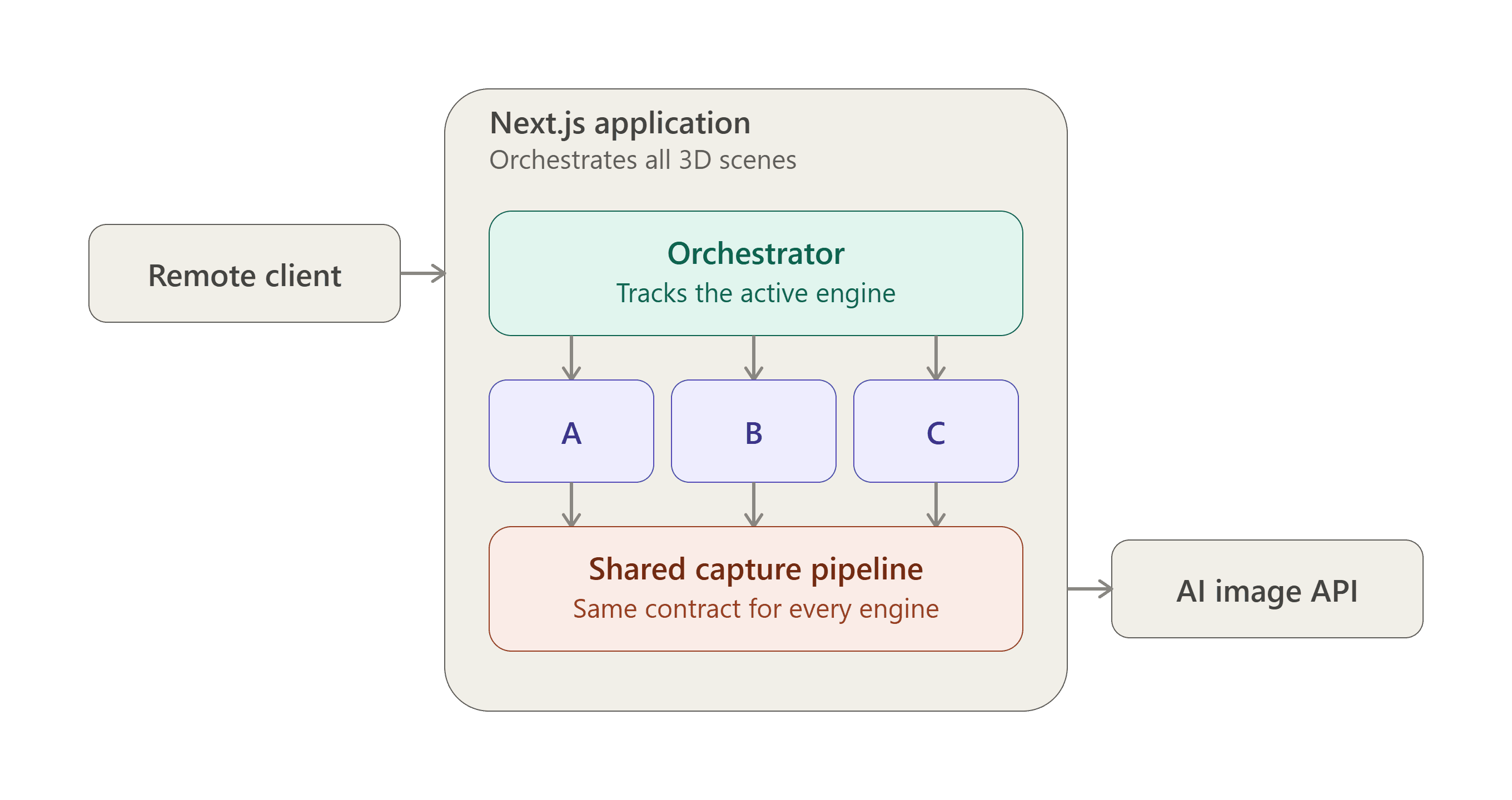
The platform renders real-estate virtual tours through several independent third-party 3D engines. Each engine runs in its own module, yet the experience had to be driven from one central place, stay in sync in real time, and support features like capture and AI editing without rewriting them for every engine.
Real-time Remote Control with Socket.io
I architected a Socket.io-driven remote-control system where a central orchestrator keeps the state of multiple independent 3D rendering modules synchronized in real time.
- One orchestrator, many rendering modules – all driven through the same event contract
- Real-time state synchronization between the controller and every active engine
An Engine-Agnostic Capture Pipeline
Instead of writing capture logic per engine, I designed a generic pipeline on top of the postMessage API that works uniformly across every integrated 3D engine running inside iframes.
- Features are added once and work across all engines – no engine-specific code
- Clean cross-iframe communication between the host app and each engine
AI Room Reframing with Gemini
I integrated a generative AI image API (Gemini) to power real-time visual editing – reframing a captured room through image-to-image generation – and hardened it for production.
- Payload size reduction and image compression before sending to the API
- Retry logic for resilient generation requests
- Cross-origin security hardening for the iframe-based pipeline
Beyond the Browser with Electron
To extend the platform beyond the browser, I built a cross-platform desktop application using Electron.js with iframe integration, reusing the same web experience.